AI for MSPs

The Questions MSPs Are Actually Asking About AI

Straight answers from 35+ years of MSP leadership. No vendor spin, no hype. What AI does to your margins, your team, and your clients.

40–60%
Ticket deflection, AI-enabled MSPs
15–25pts
Gross margin improvement potential
<120 days
Typical AI payback period
Frequently Asked Questions

Real Answers, No Vendor Spin

An AI-powered managed service is a standard MSP offering where AI handles monitoring, detection, routing, and response tasks that previously required human intervention. The MSP still owns the client relationship and the SLA. AI handles the volume work. In practical terms: instead of a technician reviewing 400 alerts per shift and escalating the 12 that matter, AI filters and prioritizes them in real time. Instead of a Level 1 tech drafting a ticket response, AI pulls from your resolution history and writes one in seconds. The service looks the same to the client. It costs you significantly less to deliver. This is different from automation scripts you may already run. AI-powered services learn and adapt based on your specific clients, environments, and patterns. A script restarts a service when CPU hits 90%. An AI-powered service understands context and decides whether a restart is actually needed.

MSPs that have fully integrated AI into service delivery report gross margin improvements of 15 to 25 percentage points on targeted services like NOC monitoring and Level 1 help desk. Ticket deflection rates of 40 to 60% directly reduce labor cost per resolved ticket. The math is straightforward. A mid-market MSP handling 1,500 tickets per month at an average fully-loaded cost of $25 per ticket spends $37,500 per month on Level 1 and triage work. If AI auto-resolves or deflects 45% of that volume, you recover $16,875 per month. Most AI tooling at that scale costs $3,000 to $8,000 per month. The net improvement is real and measurable within one quarter. The margin improvement depends entirely on how much of your current delivery is manual and repetitive.

Managed Intelligence is the operational model where AI continuously learns from your MSP's environment, including your clients' configurations, ticket histories, and resolution patterns, and improves over time. Standard automation runs fixed rules. Managed Intelligence adapts. Standard automation: disk usage hits 85%, a script runs cleanup. That same script fires for every client, every time, regardless of context. Managed Intelligence: the system recognizes that a specific client's server always spikes at month-end payroll processing, so it holds the alert rather than creating a false-positive ticket at 11 PM. The operational difference compounds over 12 to 18 months. A rule-based automation platform stays about as effective as day one. A Managed Intelligence layer gets measurably better at your specific environment and client base the longer it runs.

The three highest-ROI starting points for AI in an MSP are: • Alert triage and noise reduction in your RMM. Most MSPs are drowning in alerts, the majority of which are non-actionable. AI filtering here delivers immediate, measurable relief to your NOC team. • Level 1 ticket routing and first-response drafting in your PSA. AI that reads an incoming ticket, matches it to resolution history, and writes the first-response draft cuts average handle time dramatically. • Recurring documentation generation for clients. Monthly reports, asset summaries, and patch reports take technician time every single month. AI generates them in minutes. MSPs that focus AI on these three areas first typically cut Level 1 labor costs by 30 to 40% before touching anything else in the service stack.

For point solutions like AI-assisted alert filtering or ticket triage, 30 to 90 days from vendor selection to live deployment is realistic. Most PSA and RMM vendors have already embedded AI features that just need to be enabled and tuned to your environment. Building a full Managed Intelligence service layer, where AI is embedded across NOC, help desk, documentation, and client reporting, typically takes 6 to 12 months. The timeline depends less on the technology than on your internal process documentation and change management discipline. The most common delay is not the AI. It is the realization that your ticket data is inconsistent, your resolution notes are incomplete, or your alert thresholds have never been properly tuned. Start with 60 days of clean data hygiene before any AI vendor selection.

No. The MSPs winning with AI right now are not building anything. They are deploying vendor-embedded AI from platforms they already pay for: ConnectWise, NinjaRMM, Kaseya, Datto, HaloPSA, and IT Glue all have AI features in production today. The competitive advantage is not in the technology you build. It is in how fast you deploy what already exists and how consistently you operationalize it. Building AI from scratch requires machine learning engineering talent that most MSPs cannot hire or afford. A team of three engineers building a custom ticket classification model costs more annually than 10 years of licensing from an established vendor who has already trained that model on millions of MSP-specific tickets. The MSPs most at risk are the ones waiting for a single perfect platform rather than deploying the capable tools they already have access to.

AI creates two distinct pricing opportunities for MSPs. First, it improves margin on your existing flat-fee managed services because your delivery cost drops while your client price holds. That is the operational win. Second, it opens a premium tier. MSPs are currently packaging AI as a Managed Intelligence or Intelligent Operations add-on, priced at $15 to $30 per endpoint per month above the base managed services rate. At 500 managed endpoints, that is $7,500 to $15,000 in incremental monthly recurring revenue from clients who are already under contract. The pricing conversation works best when you can show the client a specific outcome, such as detection time, resolution speed, or breach cost avoided, not just "we use AI."

A focused AI deployment in an MSP typically pays back within 90 to 120 days when implementation targets the right workflows from the start. Example: An MSP with 10 technicians handling 1,500 tickets per month at a fully-loaded cost of $25 per ticket spends $37,500 monthly on Level 1 and triage work. AI-assisted triage and auto-resolution at a 40% deflection rate saves $15,000 per month. The tooling costs $5,000 per month. Net monthly benefit: $10,000. The implementation cost is recovered in the first quarter. ROI projections should be built on your actual ticket data, not vendor benchmarks. Pull your top 20 ticket types by volume before running any numbers. That is where your real ROI lives.

You do not lead with AI. You lead with the business outcome. An SMB owner does not care about large language models or intelligent automation platforms. They care about downtime, security threats, employee productivity, and whether their IT budget is money well spent. Frame every AI-driven improvement in terms the client can measure: • "We now detect and contain endpoint threats in under 4 minutes on average, down from 22 minutes." • "Your team logged 34% fewer IT interruptions this quarter compared to last year." • "We resolved 47 issues this month before you ever felt them. Here is the log." Once a client trusts those outcomes, introducing an AI-tier upgrade becomes a natural extension of the value conversation, not a product pitch.

The risk is not falling behind on technology. The risk is margin compression you cannot recover from. AI-enabled MSPs are already pricing more aggressively because their delivery costs are lower. They quote faster SLAs, lower per-device rates, and broader service scope at the same price point. When a prospect compares two MSPs, one running AI-assisted operations and one running standard headcount, the AI-enabled MSP wins on both price and capability. That gap widens every quarter. The MSPs most exposed are those in the 30 to 150 employee range with established but undifferentiated service stacks. They have enough scale to feel the margin pressure but not enough to absorb it through volume alone. The window to adopt AI as a competitive differentiator is narrowing.
Now Available on Amazon

Stop Watching AI. Start Leading It.

The complete AI for MSPs series — four no-fluff playbooks to help MSPs understand, operationalize, package, sell, and govern AI. Available in print and digital on Amazon.

AI for MSPs: The No Fluff Playbook
Book One

AI for MSPs: The No Fluff Playbook

Monetizing AI across the whole business

The five revenue streams, the Foundation-Build-Transform portfolio architecture, the seven core services, pricing by client size, the AI sales conversation, the delivery lifecycle, and the build versus partner versus white-label decision.

AI for MSPs: Managed Intelligence
Book Two

AI for MSPs: Managed Intelligence

The MSP Agent Operations Playbook

Defines Managed Intelligence and the five-pillar framework that makes it deliverable, then covers service tiers, pricing, the monthly operating cadence, governance policy, runbooks, and the delivery recovery playbook.

AI for MSPs: Process Intelligence & AI Readiness
Book Three

AI for MSPs: Process Intelligence & AI Readiness

The MSP Assessment Playbook

The Five-Domain AI Readiness Framework, the Process Priority Matrix, process debt, the five assessment failure modes, and the questionnaires, scoring matrices, and proposal templates to run paid assessments.
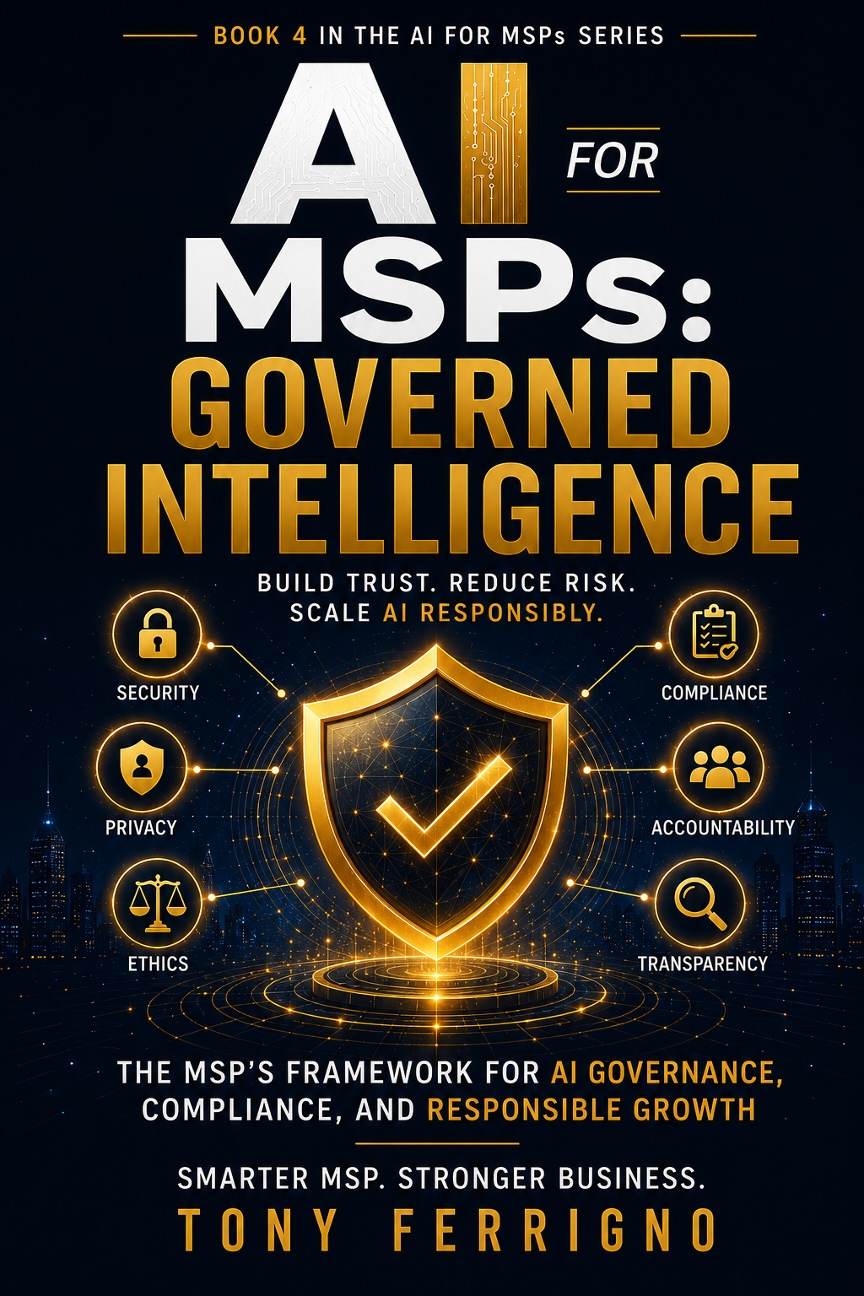
AI for MSPs: Governed Intelligence
Book Four

AI for MSPs: Governed Intelligence

Released on Sept 25th

Governance as its own managed service discipline. Policy design, audit architecture, lifecycle control, and what regulated clients will ask you to prove. Includes policy templates, an audit architecture runbook, and the monthly Governance Report framework.

Ready to stop guessing

Book a free 30-minute consultation.

No pitch. An honest conversation about where you are and what's realistic to ship in 90 days.